‘Why Forest Guards Are Becoming Central To Nigeria’s Security Strategy’ – Dr. Olasoji, Commander of Enugu Forest Guards

••• 𝑳𝒆𝒔𝒔𝒐𝒏𝒔 𝒇𝒓𝒐𝒎 𝒉𝒊𝒔 𝒕𝒘𝒊𝒏 𝒔𝒕𝒓𝒂𝒕𝒆𝒈𝒊𝒄 𝒍𝒆𝒄𝒕𝒖𝒓𝒆𝒔 𝒅𝒆𝒍𝒊𝒗𝒆𝒓𝒆𝒅 𝒂𝒕 𝑵𝒂𝒕𝒊𝒐𝒏𝒂𝒍 𝑭𝒐𝒓𝒆𝒔𝒕 𝑮𝒖𝒂𝒓𝒅 𝑻𝒓𝒂𝒊𝒏𝒊𝒏𝒈 𝑪𝒂𝒎𝒑, 𝑰𝒍𝒂-𝑶𝒓𝒂𝒏𝒈𝒖𝒏, 𝑶𝒔𝒖𝒏
Across Nigeria’s vast forest belts, ungoverned spaces have increasingly become theatres for violent crime, farmer–herder conflicts, illegal grazing, banditry, arms movement, and environmental crimes. These forests are not isolated wildernesses; they are living corridors linking farms, rural settlements, trade routes, sacred sites, and border communities. As conventional security agencies face mounting pressure, Forest Guards are emerging as a critical but often under-examined layer of Nigeria’s internal security architecture, tasked with early warning, terrain control, community intelligence, and conflict prevention in spaces where insecurity often incubates unseen, National Association of Online Security News Publishers, NAOSNP can report.
Forest Guards operate closest to these fault lines. Their effectiveness, however, depends less on force and more on legitimacy. As was repeatedly emphasised at a recent national training in Osun State, forest security succeeds only when authority is exercised lawfully, professionally, and with the consent of the communities that live and work around forest spaces. Without this foundation, security operations risk collapsing into resistance, intelligence failure, and avoidable violence.
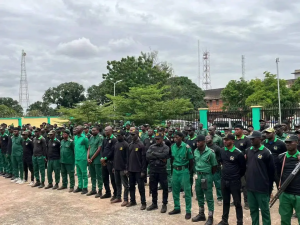
It was against this backdrop that the National Forest Guard Training Camp (“Forest Camp”) in Ila-Orangun, Osun State, hosted a set of strategic lectures in January 2026 aimed at redefining how forest security should be practiced in Nigeria. The sessions brought together recruits, rank-and-file operatives, and ward and sector formations from across the country to interrogate a central operational question: how can Forest Guards enforce the law effectively without becoming a source of fear in already vulnerable rural spaces?
The answer, according to the training, lies in a unified doctrine that places lawful authority, disciplined conduct, and community legitimacy at the heart of forest operations.
Delivered in an intensive 2–3 hour integrated format combining classroom instruction, guided discussion, and field-based application, the lectures focused on Ethics and Professional Conduct in Forest Security Operations and Community Engagement, Conflict Resolution, and Trust-Building in Contemporary Forest Policing.
Ethics as Law, Not Preference

Delivering the lectures, the Commander of the Enugu State Forest Guard (ESFG), Dr. Akinbayo O. Olasoji, Deputy Commissioner of Police (Rtd.), framed ethics as a legal obligation rather than a personal choice. He stressed that forest security authority is derived entirely from law and governance frameworks, not from uniforms, weapons, or discretion.
“Ethics in forest security is not a personal value judgment or discretionary behaviour,” he told participants. “It is a binding statutory obligation.”
He anchored this position in existing legal instruments guiding Forest Guard operations, including the Enugu State Forest Guard Law, 2020, the 1999 Constitution (as amended), the Enugu State Prohibition of Open Grazing and Regulation of Cattle Ranching Law, 2021, the Firearms Act, the Administration of Criminal Justice Act, and the Evidence Act, 2011, alongside public service rules and recognised law-enforcement ethics standards. Reinforcing a core operational doctrine of the ESFG, he declared: “Authority exists only within the law.”
𝗕𝗨𝗜𝗟𝗗𝗜𝗡𝗚 𝗦𝗘𝗖𝗨𝗥𝗜𝗧𝗬 𝗧𝗛𝗥𝗢𝗨𝗚𝗛 𝗧𝗥𝗨𝗦𝗧, 𝗡𝗢𝗧 𝗙𝗘𝗔𝗥
Beyond legality, the lectures placed strong emphasis on community legitimacy as the foundation of effective forest security. Dr. Olasoji reminded operatives that forests are not empty spaces, but environments connected to daily human activity and livelihoods.
“Forests are not isolated zones,” he explained. “They are linked to farms, settlements, markets, footpaths, and sacred sites. That reality makes community partnership a decisive operational factor.”
According to him, the consequences of poor community engagement are immediate and severe. He warned that mistrust leads to intelligence breakdowns, delayed early warning, increased hostility toward operatives, and the escalation of minor disputes into violent confrontations, outcomes that ultimately endanger officers themselves.

In contrast, he argued, trust transforms communities into security partners. As he put it:
“Community engagement is not weakness; it is operational strength. Trust is a force multiplier. When you win the community, you win the forest.”
𝗡𝗢𝗡-𝗡𝗘𝗚𝗢𝗧𝗜𝗔𝗕𝗟𝗘 𝗦𝗧𝗔𝗡𝗗𝗔𝗥𝗗𝗦 𝗢𝗙 𝗖𝗢𝗡𝗗𝗨𝗖𝗧
The sessions translated ethical principles into concrete operational standards applicable to patrols, checkpoints, arrest support, intelligence handling, and inter-agency cooperation. Participants were reminded that public confidence and mission success rise or fall with officer conduct.
Among the non-negotiable standards reinforced were universal human-rights compliance, lawful and proportionate use of force, zero tolerance for torture, brutality, corruption, extortion, or record falsification, strict confidentiality of operational information and informant protection, and political neutrality.
Human-rights compliance, Dr. Olasoji stressed, “applies to everyone, always,” while the use of force must satisfy “lawfulness, necessity, and proportionality.”
Mandatory reporting of misconduct, supported by whistle-protection safeguards, was also emphasised as an institutional duty rather than an individual risk.
𝗗𝗘𝗖𝗜𝗦𝗜𝗢𝗡-𝗠𝗔𝗞𝗜𝗡𝗚 𝗨𝗡𝗗𝗘𝗥 𝗣𝗥𝗘𝗦𝗦𝗨𝗥𝗘
To strengthen field judgment, the lectures adopted a practical ethical decision model consistent with international enforcement doctrine: L-N-P-A — Legality, Necessity, Proportionality, Accountability.
Operatives were trained to ask four questions before acting: Is it lawful? Is it genuinely required? Is it the minimum reasonable response? Can it be defended openly, in writing, and before lawful authority?
The guiding rule, as repeatedly emphasised, was uncompromising:
“If you cannot defend it, don’t do it.”
𝗘𝗔𝗥𝗟𝗬 𝗪𝗔𝗥𝗡𝗜𝗡𝗚 𝗔𝗡𝗗 𝗖𝗢𝗡𝗙𝗟𝗜𝗖𝗧 𝗣𝗥𝗘𝗩𝗘𝗡𝗧𝗜𝗢𝗡
A major focus of the engagement lecture was early warning and early response. Participants were trained to identify indicators such as rumour patterns, unusual movement along forest corridors, resource-pressure signals linked to farmer–herder tensions, and enforcement-related triggers capable of igniting rapid conflict.
Forest Guards, Dr. Olasoji explained, are not merely enforcers but stabilisers.
“Forest Guards are peace managers,” he noted, “but they must operate strictly within legal limits.”
A standard dispute-management workflow was reinforced: Assess, Stabilise, Separate, Dialogue, Decide (Enforce or Refer), Document, Report, and Follow-up, with clear thresholds for referral to the Police, DSS, courts, and civil authorities.
𝗛𝗜𝗚𝗛-𝗦𝗘𝗡𝗦𝗜𝗧𝗜𝗩𝗜𝗧𝗬 𝗘𝗡𝗙𝗢𝗥𝗖𝗘𝗠𝗘𝗡𝗧: 𝗢𝗣𝗘𝗡 𝗚𝗥𝗔𝗭𝗜𝗡𝗚
Given the sensitivity of open-grazing enforcement nationwide, the lectures stressed that operations must remain calm, law-based, non-discriminatory, and free of harassment, extortion, ethnic profiling, or improper impoundment. Ethical professionalism, participants were told, is central to preventing rural instability and escalation in mixed-use forest zones.
TRAINING, ACCOUNTABILITY, AND INSTITUTIONAL RESPONSIBILITY
The sessions employed scenario-based learning, decision drills, and misconduct case studies to ensure practical understanding. Ethics and community-engagement competence were presented as mandatory core requirements, forming part of refresher training and promotion criteria, with completion formally recorded in personnel files.
Responsibility for trust-building was distributed across the command structure, from state and zonal commands to sector, ward, and frontline formations, embedding accountability into institutional culture.
𝗔 𝗕𝗥𝗢𝗔𝗗𝗘𝗥 𝗡𝗔𝗧𝗜𝗢𝗡𝗔𝗟 𝗟𝗘𝗦𝗦𝗢𝗡
In one of the most quoted moments of the lectures, Dr. Olasoji told participants:
“A Forest Guard is a trust-bearer, not a power-holder. Uniform and equipment do not create authority; character does. Without integrity, authority collapses.”
Security analysts say the Ila-Orangun engagement underscores a broader national lesson: that sustainable forest security in Nigeria depends less on coercion and more on professionalism, legality, and partnership with communities.
As Nigeria continues to grapple with insecurity across rural and forested regions, the lessons from Ila-Orangun point to a clear conclusion—when Forest Guards operate within the law and with the people, forests shift from being security liabilities to strategic assets in national security management.