OPINION: When Is The Pope’s Next Visit To Nigeria? – By Peter Ajayi Dada
From April 13 to 23, 2026, Pope Leo XIV embarked on a 10-day spiritually and politically successful Apostolic Journey to Algeria, Cameroon, Angola, and Equatorial Guinea respectively. The nationals of those countries must have now begun to count their blessings and gains after the visit just as Nigeria and Nigerians did after Pope John Paul II’s first and second pastoral visits to Nigeria in 1982 and 1998 respectively.
For the records, Pope John Paul 11, now Saint John Paul11, during his Pontificate visited Nigeria first , between 12th and 17th February, 1982 during the tenure of President Shehu Shagari of blessed memory and from March 21st to 23rd 1998 when General Sani Abacha also of blessed memory was Nigeria’s Military head of State respectively.
The fruits of those pastoral visits to Nigeria are still very refreshing and evergreen in our memories. Spiritually, some 81 young Nigerians who had completed their seminary trainings in various major seminaries then were ordained priests in 1982 in Kaduna by Pope John Paul 11. He visited Onitsha and Ibadan where he celebrated Holy Masses and interacted with Nigerians of diverse backgrounds before rounding up the visit with the Holy Mass at the Holy Cross Cathedral, Lagos.
In 1998 during his second Apostolic Journey to Nigeria, he performed the beatification of a Nigerian priest and monk, Blessed Cyprian Michael Iwene Tansi as well as identified with Nigerians who were under the Abacha political persecution and pleaded for their release.
Bishop Matthew Hassan Kukah of the Catholic Diocese of Sokoto was the Secretary General of the Catholic Secretariat of Nigeria (CSN) during the 1998 preparations of the Pope’s visit and the Secretariat were neck-deep. Bishop Kukah reminiscing on his experience during and after the Pope’s visit in the preface to his book titled ; “WHISTLING in the DARK :Selected interviews during the Abacha Era’’ recalled ; “ Perhaps , my most memorable time during the entire Abacha years was the visit of the Holy Father in March 1998. The Holy Father came at a time Nigeria needed him most. In 1982, his visit had served to give a fillip to the efforts of the Alhaji Shehu Shagari –led administration which with all its sins, was doing much for national integration and seeking to build bridges across the nation.
“But the 1998 visit was even more exciting in timing and essence. “There were varieties of expectations. Every segment of the severely fractured Nigerian polity wanted a piece of the Holy Father’s blessings. The late General Sani Abacha and his henchmen and women were waiting and hoping that the Holy Father would bless and endorse their programme of seeking a seeming political eternity through the self-succession bid. Civil society had been traduced and lay prostrate . The lucky ones in NADECO were abroad while others were living in internal exile at home. The Catholic Bishops Conference had taken a firm stand on the side of the people of Nigeria. I was in the middle of these very exciting times for our nation and our Church,’’ Kukah recalled.
Today, has Nigeria overcome the challenges that rocked the nation before the visit of Pope John Paul11 in 1998? Though, there are no-known political prisoners compared to the days of General Sani Abacha and his hatchet men. But, we have bribery and corruption, embezzlement of public funds , kidnappings, terrorism, abduction, insurgency, hostage taking for ransom, cybercrime, ritual killings, hardships of monumental proportions, all stirring us in the face as the norm. We have lost count of innocent Nigerians that had met their untimely deaths from the hands of Boko Haram insurgents, those that had fled their ancestral homes due to incessant attacks by herders mostly in Benue and Plateau States, military officers on peace mission being attacked and killed by bandits, various innocent people falling victims of armed robbery attacks either on the highways or in their private homes across the country. The most disgusting now being the abduction of toddlers and primary school children and their teachers from their schools with the most recent happening in rural communities of Oriire Local Government Area of Oyo State in daylight. , Boko Haram insurgency has become a daily recurrence since 2009 in Northeastern Nigerian States of Yobe, Adamawa and Borno. Several youths, for lack of genuine job opportunities, had resorted to ritual killings, hostage taking for ransom, cybercrime, social miscreants, political thugs, cattle rustling, indeed the list is unending.
The indigenes and herders incessant clashes, and the Boko Haram insurgency have become the norm in Northern Nigeria. Their incessant virulent attacks had led to the death of tens of thousands of innocent lives while several others had fled their ancestral homes into IDP camps for safety. Several illustrious Nigerians are cooling off in foreign prisons for offences they committed against their fellow human beings while holding public offices or still thinking they were still in power and had authorities to do anything and get away from it. Indeed, the cost of living today is of geometrical proportion. It was better life for Nigerians in 1998 than now in many ramifications as several Nigerians cannot afford three square meals, and the unemployment rate is soaring high.
Are all the above not enough for the Universal Head of the Catholic Church to consider visiting Nigeria 28 years ago after John Paul II made his last visit to Nigeria? The 1982 and 1998 visits brought stability, peace , and international attention to the political impasse that pervaded the country then. That 1998 visit was and is the soothing balm that helped to heal our fractured wounds as a country under political insurrection then and the greatest elixir that facilitated the democratic dispensation in 1999 that Nigeria is still enjoying till date.
It also deepened the spiritual lives of many Catholic faithful when the then Pope performed the beatification of a Nigerian monk and priest, Blessed Cyprian Michael Iwene Tansis. By that, Catholics and non-Catholics alike believed that they had a holy man from their own country in heaven whom they can pray through, to intercede for them alongside other saints and blessed people for peace, justice, love , unity and humility to reign in Nigeria and thus facilitated the ever-sought-for development. It was, indeed, a great joy that a Nigerian could be raised to that exalted spiritual position when the world had regarded Nigeria as a pariah nation because of the human rights abuse of General Sani Abacha-led administration then as several nations had severed bilateral relations with the government then.

As a reporter then, I had the unique privilege of joining a very senior colleague, Mr Wale Ademowo, to cover the beatification of Blessed Cyprian Iwene Tansi at Oba near Onitsha in present day Anambra State for the African Newspapers of Nigeria PLC, Publishers of the Tribune titles. Otunba Ademowo as he was fondly addressed then and myself trekked from the Onitsha City Centre to Oba, the venue of the beatification in the dead of the night without anybody thinking of being kidnapped or abducted. The population of pilgrims there was densely as if all Nigerians had trooped down to Oba. It was spiritually grandeur, memorable and remains evergreen.
The altar -podium where Pope John Paul 11concelebrated alongside other Cardinals , Archbishops and Bishops the Mass for the beatification was a whispering distance from that of the gentlemen of the press that covered the event. Fortunately, security challenges had never entered the brains and mindsets of Nigerians then compared to what we experience today.
Kukah also recalled that the list containing the names of the supposedly political prisoners the then Secretary of State at the Vatican, Cardinal Sodano, handed over to Abacha’s Minister of Foreign Affairs, Chief Tom Ikimi, a Papal Knight of the Catholic Church for onward presentation to General Abacha during the open air national Mass at Abuja was a diplomatic masterstroke. The Pope had pleaded with General Abacha for the release of `presumed’ political prisoners during a close-door meeting between the two heads of state.
Those who have been following the trend of developments in Nigeria between 1998 and 2026 would agree with me that we need the physical presence of the Pope in Nigeria, to come and pray with us, to come and personally appeal to herders and farmers to sheathe their swords and stop splitting innocent blood , to Boko Haram insurgents to stop their attacks against innocent people , to kidnappers and abductors who do that for ransom to have a rethink because whatever we acquire in this world is vanity upon vanity, to cattle rustlers to let peace reign again in Nigeria, to tell Nigerians that we should be our brothers and sisters’ keepers and not killers. That we should return to promoting justice, development and peace among ourselves. That, we should have a rethink by saying NO to insecurity but embrace security in every nook and cranny of Nigeria.
All these social malaise and others not mentioned had received condemnations and criticisms not only from the local but also from international communities including the Vatican State in forms of press statements . Hence, the incumbent Pope should consider putting A VISIT TO NIGERIA on his itinerary as a matter of urgency.
I begin to wonder whether the PRAYER FOR NIGERIA IN DISTRESS and the PRAYER AGAINST BRIBERY AND CORRUPTION IN NIGERIA composed by the Catholic Bishops Conference of Nigeria some decades ago and still be prayed across Catholic Churches in contemporary times are of any positive impact.
The Pope during his recent visits to Algeria, Cameroon, Angola and Equatorial Guinea in April 2026, prayed with and for citizens of those countries, had on-the-spot assessments of the human, material and natural challenges affecting their citizens , and offered them words of courage, peace and brought succour to patched throats and served as the oasis to a wandering desert. Nigeria and Nigerians need such spiritual palliatives now .
The Catholic Bishops Conference of Nigeria (CBCN) is an active–member conference of the Regional Conferences of West Africa (RECOWA} and the Symposium of Episcopal Conferences of Africa and Madagscar (SECAM) . I , therefore, plead with them to dialogue with their brother Bishops from others Conferences that have had the unique honour of hosting either of the three Popes after John Paul11 vis: Popes Benedict XVI, Francis and the current Pope LeoXIV on how they went about it and how our Bishops can apply such methodology and strategy for the good of Nigeria and Nigerians as soon as possible. Nigerians at home and in the Diaspora need the blessings of the Pope, we all need his spiritual and physical presence and advice as many Nigerians still recall the wonderful experiences of what happened before, during and after the Pope’s visit to Nigeria in 1998 with nostalgia.
Coincidentally, early this year, the almost 60 Bishops making up the CBCN were on their ad-limina Apostolorum to the Vatican; this is a statutory visit by Catholic Bishops from various conferences all over the world once in five years. There and then, they would renew their individual loyalty to the Holy Father and give an account of their diocesan stewardships, progresses made and challenges they encountered after their last visit . I had expected them to have seized the same opportunity to extend an invitation to Pope Leo XIV. If they had done so then, they should embark on committed follow-ups by discussing and involving the Federal Government of Nigeria about such a noble intention. Nigeria has both the Catholic, Christian and Citizens’ population that will encourage the current Pope to visit Nigeria after that of Saint John Paul11’s second visit over 28 years ago. The present Catholic Bishops Conference of Nigeria should strive to repeat the feats that less than 20 CBCN members achieved in 1982 and which 31 CBCN members achieved in 1998 respectively.
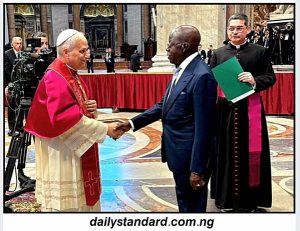
President Bola Ahmed Tinubu attended the Mass for the initiation of Pope Leo XIV into the Petrine Ministry of the 267th Bishop of Rome and the incumbent Head of State of the Vatican City in May 2025. So, both the Pope and President Tinubu are brother heads of states of their respective countries; hence President Tinubu can also leverage that rapport to extend an invitation to Pope Leo XIV to visit Nigeria. I implore President Bola Ahmed Tinubu to make it a priority. The excuse has always been that the Pope has a busy schedule. Notwithstanding that, he found time to visit four countries on the African continent few months ago, let the CBCN impress it on the Dicastery in charge of arranging the Pope’s Apostolic Journey at the Vatican that now is our turn to receive the Pope.
Peter Ajayi Dada, is a Retired Deputy Editor-in-Chief, News Agency of Nigeria